

The Key to Understanding Family Relationships
| Tweet |
|
In most cultures, extended family members interact with each other. For example, guests at a wedding are often distant relatives of the bride or groom. Similarly, witnesses on a marriage license are also often distant relatives. These are the kinds of records people come across when tracing their ancestors. Knowledge of how people are related to each other can provide useful clues when looking at such records.
The easiest way to determine how two people are related to each other is to use what is formally known as a canon law relationship chart, but what is more commonly referred to as a Family Tree Relationship Chart. GenealogyInTime Magazine has created one below for your personal use.
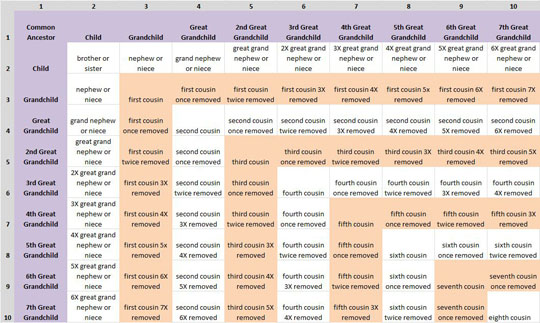
The Family Tree Relationship Chart works on the principal of finding the common ancestor between any two people. In other words, to determine the relationship between two people in a family tree, it is necessary to know what direct ancestor the two people had in common.
This could be a parent, grandparent, great grandparent, great great grandparent, etc. It has to be the same common ancestor for both people. However, the relationship to the common ancestor does not have to be the same for each person. For example, for one person, the common ancestor could be their grandmother, and for another person the same person could be their great grandmother.
Once the common ancestor has been identified, it is a straight forward exercise to determine the relationship between any two relatives. It is simply a matter of looking it up on the Family Tree Relationship Chart.
Find the first relative on the first row of the chart (the purple row). The second relative is put on the first column of the chart (the purple column). The point where the row and column intersect is the relationship between the two relatives.


